
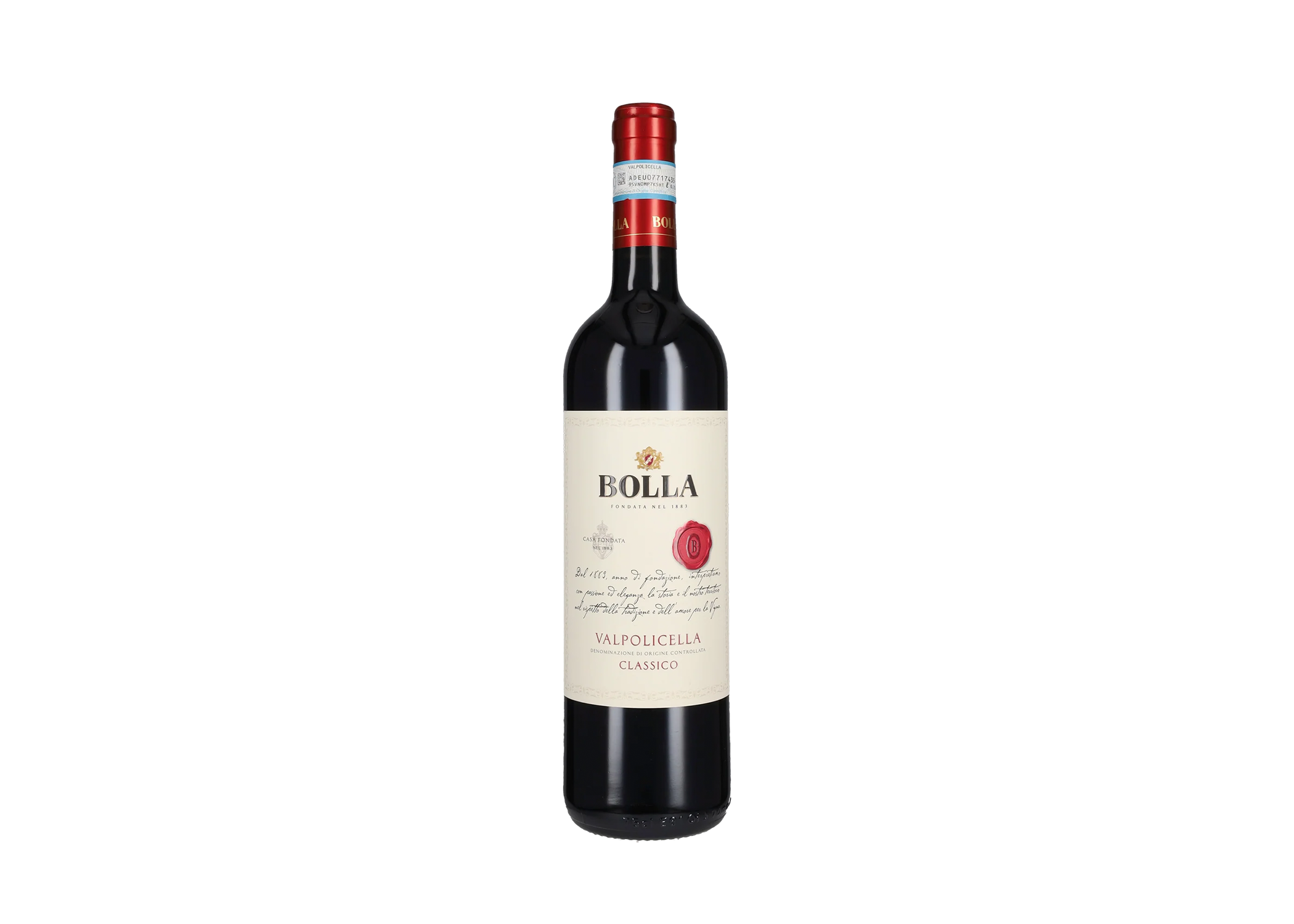
Today I am going to be tasting the LL Cool J wine. And you’re asking, why do you call it that? Because — don’t call it a comeback. It’s been here for years.
This is the Bolla Valpolicella Classico.
Who helped put Italian wine on the map in the United States? Bolla was one of the first brands imported into the United States, I believe in the early seventies, if not the sixties. A little bit before my drinking time. But back in the day, if you went into a specialty wine store, Bolla dominated the Italian wine category. It was the brand. That along with its Valpolicella, its Bardolino, and of course its Soave. Obviously new packaging now, but they’ve been there forever.
I’m not sure what really took them out of the market, whether they ever officially left, whether it was an importer thing. But literally a lot of Italian wines that are now widely distributed in the United States owe a lot to Bolla.
So: Valpolicella. It’s an area in the Veneto region of northern Italy — the area in between Milan and Venice. That’s the Veneto, and that’s right where Valpolicella is. If you are driving from Milan toward Venice, or taking the train, you will pass directly through Valpolicella on the autostrada. Gorgeous area. Hilly but not mountainous. Mediterranean climate, if you will.
Valpolicella is a workhorse wine in that area. A lot of volume. A lot of tiny wineries, but also a lot of massive ones.
What is Valpolicella? Valpolicella is the name of the wine, and it’s also the name of the area. And it’s a blend — Corvina, Rondinella and Molinara are the three main grapes. But Corvina is the king of grapes there, and that’s what goes into making Valpolicella.
Valpolicella is one of the few red wines, in my opinion, where you can put a slight chill on it and it will go just as well with lake fish, lake trout, as it will with a grilled meat.
And the cat daddy version of Valpolicella, as it goes up the pecking order, becomes Amarone. You can get Ripasso along the way, and then it becomes Amarone. Same grapes, different process. We’ll get to that another time.
I haven’t tasted Bolla in forever, and they’re making a comeback. They’ve changed their packaging. Let’s see what we’ve got here.
This is a wine that’s going to be somewhere right around ten to twelve bucks. Which these days — given the dollar and the tariffs and everybody along the chain needing to get their pound of flesh — is not a bad price. But the most important thing is what does it taste like.
The aromas here are like highly extracted dried flowers. Potpourri, but not in a perfumey sort of sense — just in a dried flower sort of a thing. Along with some hickory notes, almost like smoked barbecue, but subtle. Nothing unpleasant at all. It’s a combination of red fruit and black fruit. It’s like hickory and rhubarb mixed together on the nose, which is interesting, but I like it.
There we go.
Show me anything from anywhere in the world for twelve bucks where you’re getting this kind of flavor profile, this kind of balance, this kind of ability to pair with food. I just think about what is coming out of California that’s twelve dollars on the shelf — and I’m not drinking it. I haven’t had it. I haven’t had a wine from California that’s twelve dollars or less worth a poop in twenty years, quite honestly. And there are a lot of different reasons for that. That’s a whole different discussion.
But the fact that this can be made in Italy, come all the way from Italy, and land on a shelf here for twelve bucks for what you’re getting — I think about that. Even Côtes du Rhône. There were some great values from Guigal. I’m not even sure what Guigal costs now, but it used to be that for twelve bucks it was a no-brainer. No reason to drink anything else from California, once I got hip to that one. But then a whole gang of stuff from Italy came out, and this is still around the ten-to-twelve-dollar mark. And I’m like: all day, every day.
This is a pizza-night wine. It still has structure. It has good balance. It has great acidity. And it’s a mouth-filling wine without being an over-the-top wine.
Let me taste it again. It’s dried cherries. There’s a bitter bit, probably from the skins — which with Corvina I feel like there should always be a little bitterness. But when I say bitter, I don’t mean it in an unpleasant way. Just enough to give it some grit to keep up with the food. You always want some of those grippy little tannins. Even though this is a light-bodied wine with light tannins, there’s enough there that it should be able to hold up on its own.
You could put a slight chill on this — and I do mean slight, because it’s not really full enough to put a heavy chill on it. But put a slight chill on this with a light grilled fish and you’re in the money here all day long. Even with a chicken salad. But with a grilled lake fish, so you’re getting some of the smoke from the grill onto the fish while it’s still a very lean fish — this wine would work impeccably well.
It’s a beautiful wine. Hats off to the boys over at Bolla. Who knew they were doing it like this at this point? It’s good to see.
And I think I’ve got a bottle of their Soave around here. I can’t wait to taste it. I have no doubt it’s going to be on par qualitatively with the Valpolicella.
But it’s great to see that for ten or twelve bucks you can still get a great bottle of imported wine here in America.
So anyway — until next time, take care, give Bolla a shot, and stay well.